Load “Low voltage”
Inspect the power-quality reading and the creper's available capacity. Watch work in progress accumulate upstream.
A connected production line that makes the relationship between machinery, inputs and output visible.
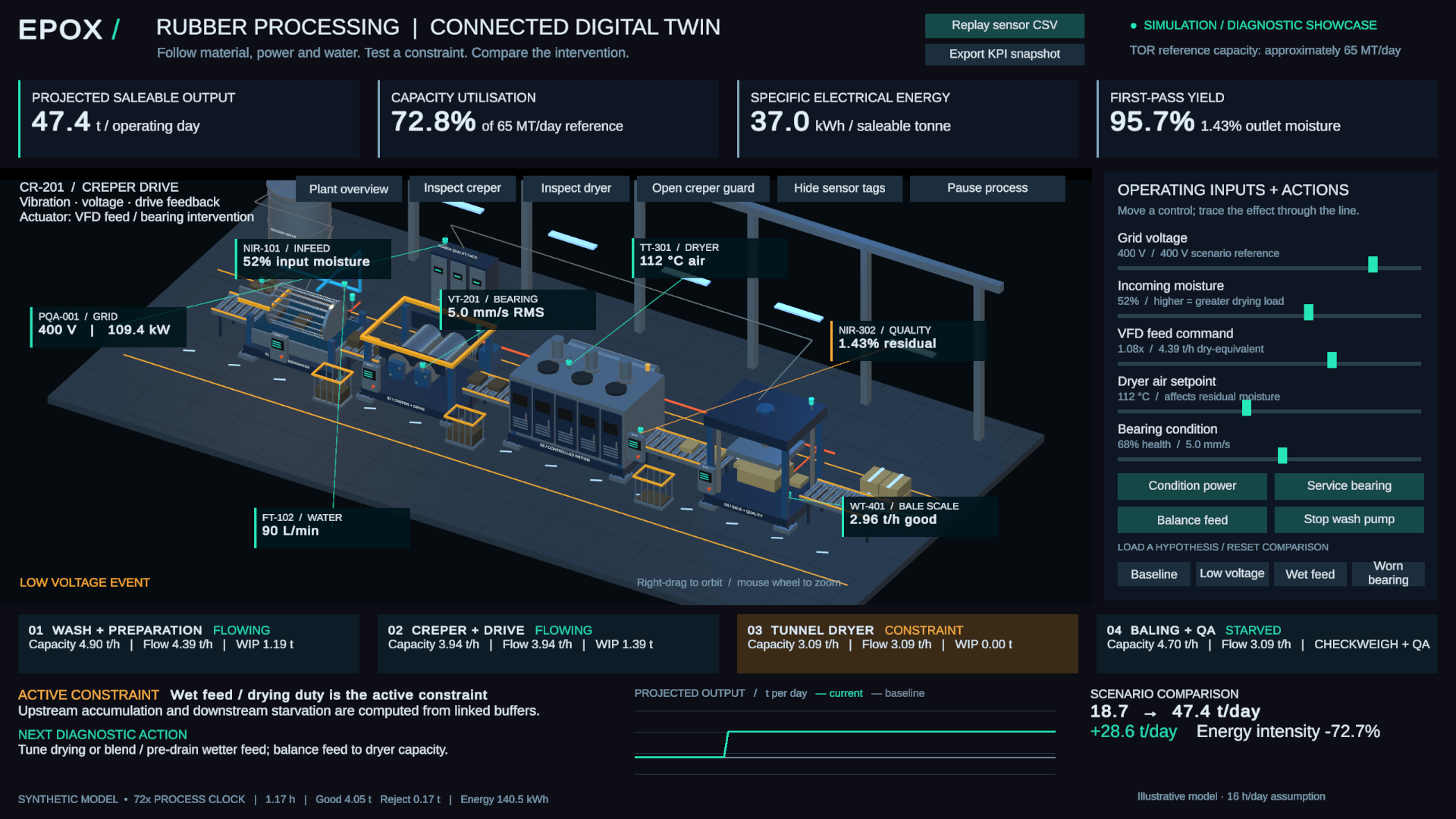
Start with a hypothesis, apply an intervention, then check whether another stage becomes the constraint.
Inspect the power-quality reading and the creper's available capacity. Watch work in progress accumulate upstream.
Compare projected saleable output and electrical energy per tonne. Follow the constraint as it moves to the dryer.
Inspect the rollers, drive and bearing sensor. Try a worn-bearing scenario, wet feed or loss of wash-water flow.
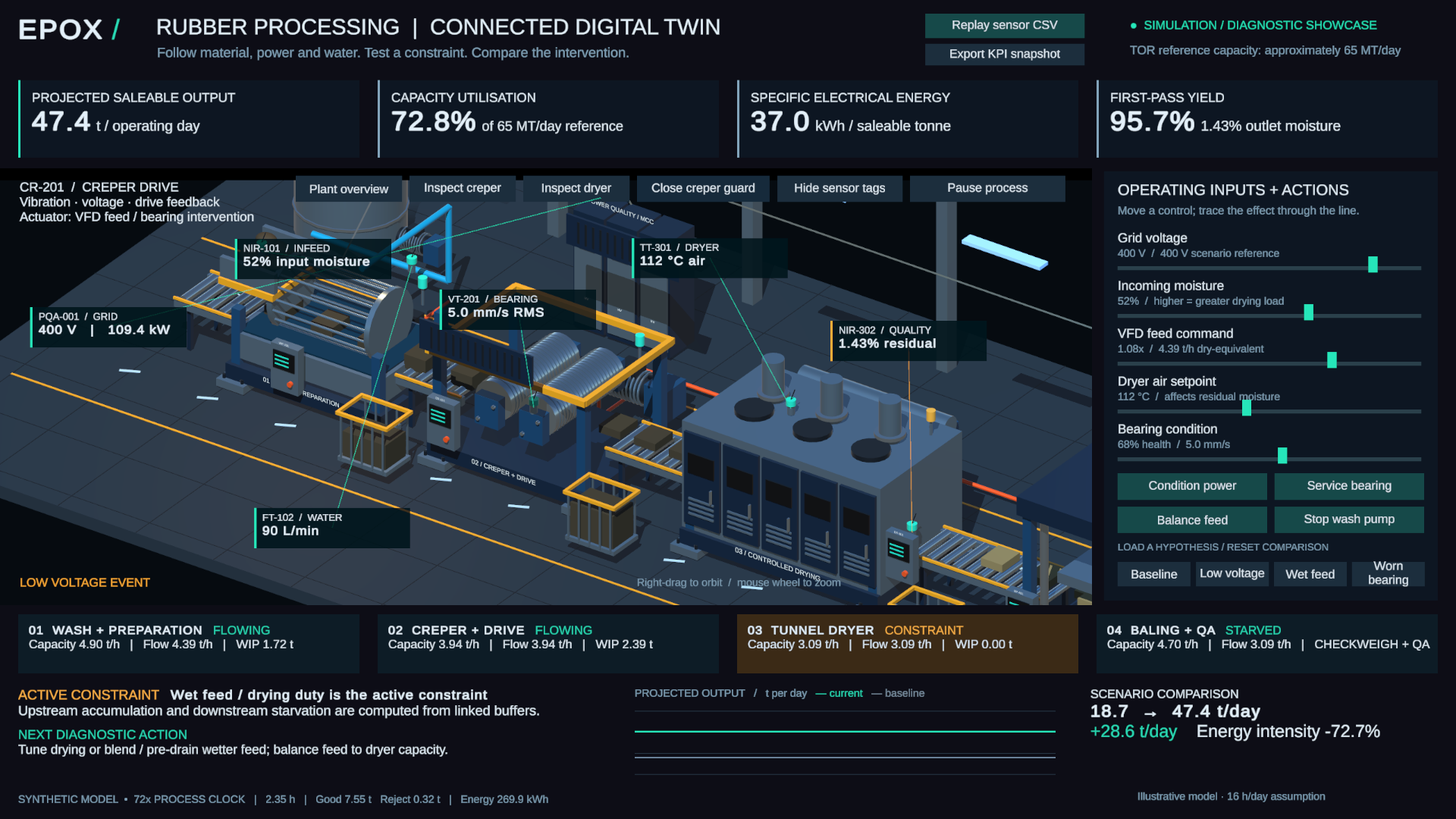
The model links washing and preparation, creping, drying, and baling. Material buffers, first-pass yield and energy demand respond to changes in operating conditions.
Replay a supplied sensor CSV, then export a JSON snapshot of the scenario and its KPIs from inside the demo. Download the synthetic sensor CSV ↗
All operating readings are synthetic. The equipment geometry, response coefficients, quality rules and scenarios are illustrative. The 65 MT/day capacity reference uses an explicit 16-operating-hour-day assumption in the model.
Projected output is a steady-state comparison. Accumulated good and rejected tonnes follow the linked material-flow simulation. The public demo has no live plant connection and does not control physical equipment.
A real deployment would map validated, timestamped PLC and instrument data into the twin and calibrate its relationships against observed production.
Loading the 3D model and operating controls…
0%